
Where to Invest in Your Kitchen: A Designer’s Take on Countertops
When clients come to me at the beginning of a kitchen project, countertops are almost always one of the hardest decisions.
There are so many options, and everything looks good in photos. But what matters more is how it will actually live in your home.
What I have learned over time is that the goal is not just to choose something beautiful today. It is to choose something that will still feel right years from now.
That is where materials really matter.
And lately, I have noticed a shift in how designers are approaching this.
Instead of selecting countertops at the end, some are actually starting with the slab and designing the kitchen around it.
When you think about it, it makes sense. These materials can be one of the most impactful elements in the space. When you treat them as a focal point instead of an afterthought, the entire kitchen feels more intentional.
Not every project needs to start this way, but it speaks to something important.
The materials you choose are not just a detail. They are an investment that shapes how your kitchen feels every day.
What It Means for a Material to Age Well
A material that ages well does not stay perfect. It changes over time in a way that still feels good.
Natural materials tend to do this better. They soften, they develop character, and they feel more lived in. That can be a really beautiful thing if you are expecting it.
Other materials are made to look consistent and clean all the time. That works for some people, but when they start to wear, it can feel more noticeable.
This is where lifestyle comes in.
Some clients want something that feels relaxed and layered. Others want something simple and easy to maintain. Neither is wrong, but the material should match how you actually live.
Understanding the Materials
Before we get into specific options, it helps to understand what these materials actually are.
Quartz is a man made product. It is created by combining crushed natural stone with resins and pigments to create a consistent, controlled surface.
Marble, granite, and quartzite are all natural stones. They are quarried from the earth, which means every slab is unique. The variation, movement, and subtle imperfections are part of what make them feel so special.
This difference alone often helps guide the decision.
If you are drawn to something that feels organic and one of a kind, natural stone usually resonates more.
If you prefer consistency and predictability, quartz can be a better fit.
A Quick Comparison
When clients are comparing options, it can be helpful to see everything side by side.
This is a simple breakdown of the most common countertop materials and how they tend to perform. There is always variation within each category, especially when it comes to price, but this gives a general starting point.
| Material Type | What It Is | Look and Feel | Maintenance | Durability | Price Range |
|---|---|---|---|---|---|
| Quartz | Man made with stone and resin | Consistent, controlled pattern | Very low, no sealing | Moderate, can be damaged by heat | $$–$$$ |
| Marble | Natural stone | Soft, classic veining, timeless | Moderate, Seal Recommended | Softer, can etch and stain | $$$–$$$$ |
| Quartzite | Natural stone | Natural movement, similar to marble but more depth | Moderate, requires sealing | Durable, more resistant than marble | $$$–$$$$ |
| Granite | Natural stone | Wide range, from subtle to bold | Low to moderate, sealing recommended | Very durable and heat resistant | $$–$$$ |
Quartz

Quartz is often the easiest choice.
It is low maintenance, it does not need sealing, and the pattern is consistent. For busy households, that can be a big advantage.
But I always tell clients, you have to be discerning when choosing quartz.
The best quartz options are the ones that feel like they could be natural, even though they are not. Softer movement, subtle variation, nothing too repetitive.
I tend to stay away from large, dramatic veining in quartz. It often feels forced and not quite believable, which can take away from the overall feel of the kitchen.
One thing that does surprise people is that quartz is not heat resistant in the way natural stone is. Most manufacturers recommend not placing hot pans directly on the surface because it can damage the resin.
For some clients, that is not a big deal. For others, it is a deal breaker.
It is just one more reason to think about how you actually use your kitchen before deciding.
When it is chosen well, quartz can be beautiful. It just takes a more careful eye.
Marble
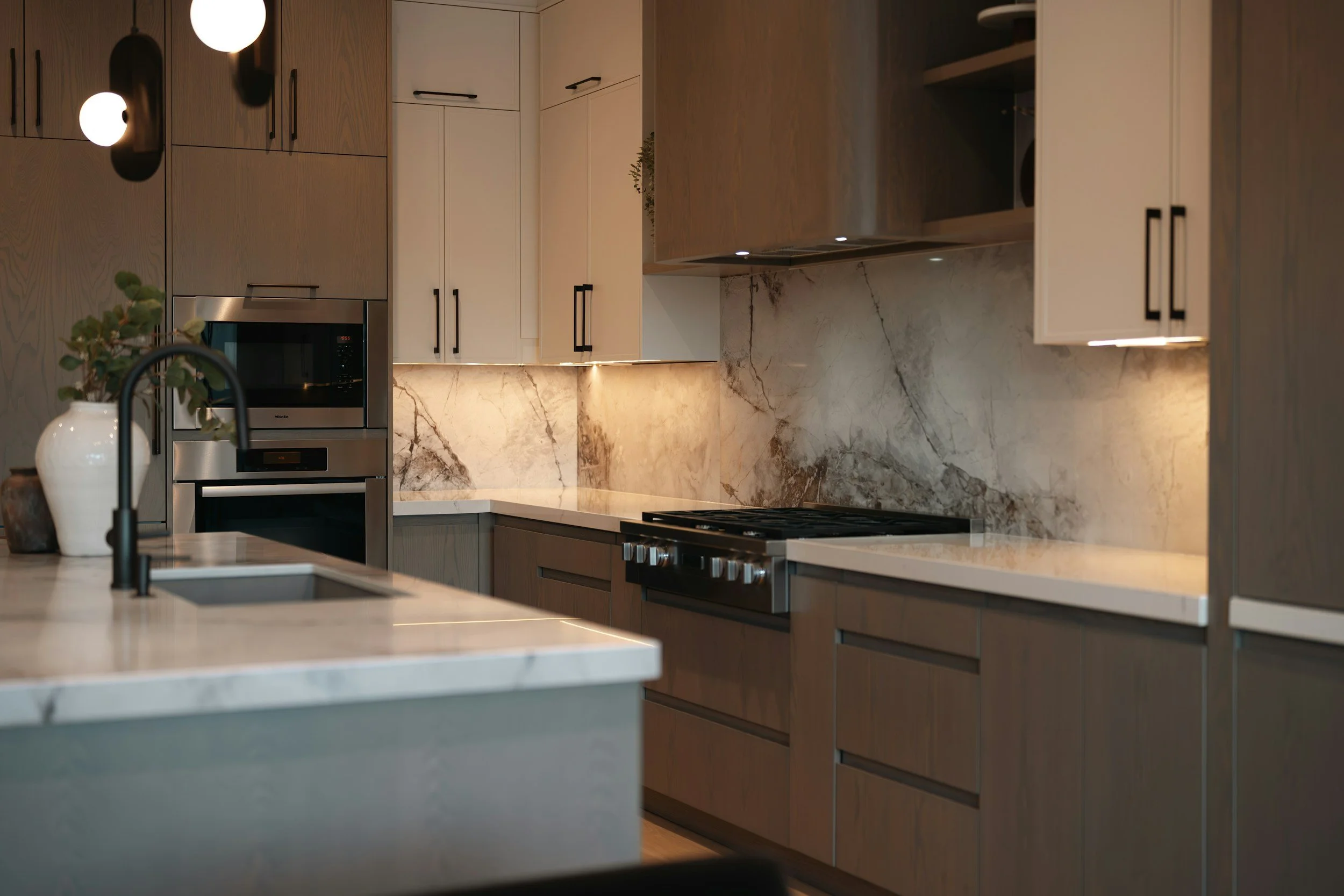
Marble is one of the most beautiful materials you can use, and it is definitely making a comeback.
For a long time, I found myself steering clients away from it because it does stain and etch more easily.
But that conversation has shifted.
There are now sealers that do a really good job of protecting marble and making it much more usable in a kitchen than it used to be.
That does not mean it is maintenance free, but it is far more livable than people think.
And honestly, nothing quite compares to the softness and movement of real marble. It brings a level of warmth and character that is hard to replicate
Quartzite
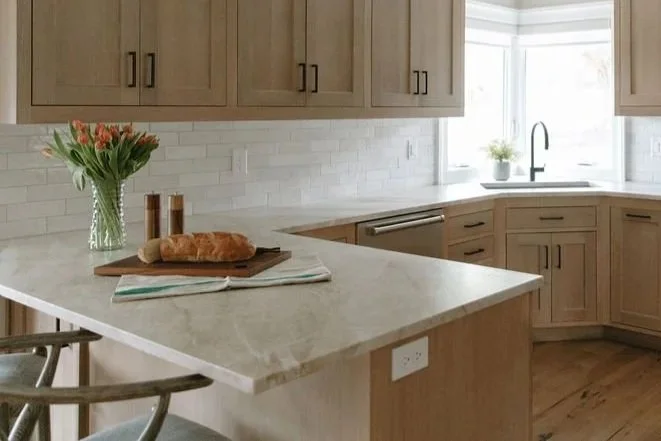
This is where I have been leaning more lately.
Quartzite is a natural stone, and that comes through in the way it looks and feels. It has the softness and movement of marble, but it is more durable.
It gives you that natural, elevated feel without quite as much worry.
It does need to be sealed, and every slab is a little different, but that variation is part of what makes it feel special.
When you see it in a space, it has a depth that is hard to replicate with anything manufactured.
Granite
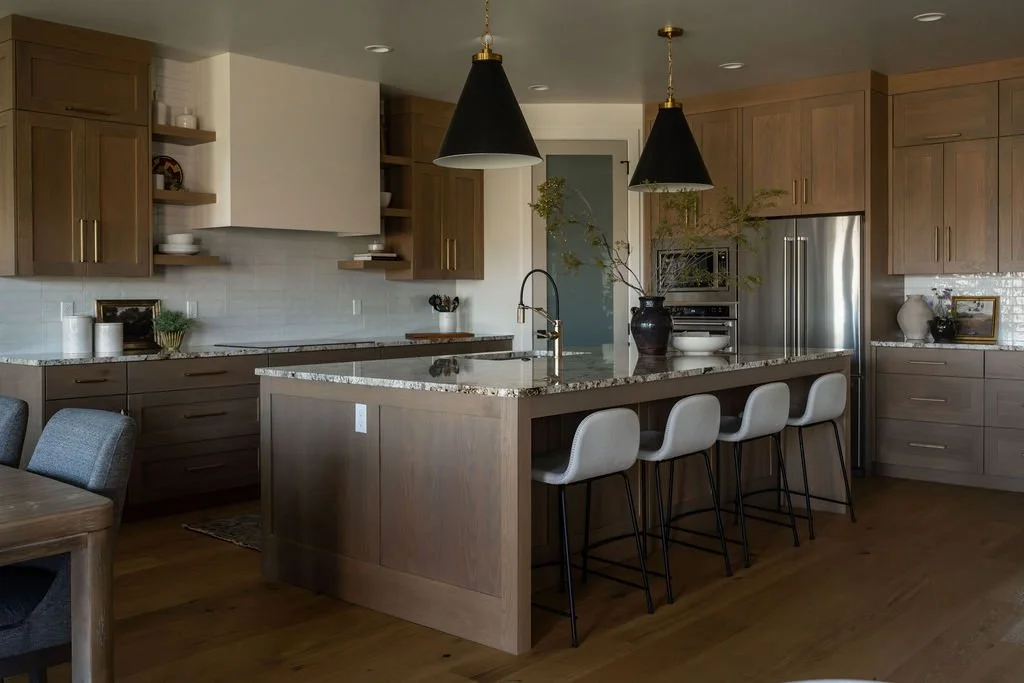
Granite is also a natural stone and one of the most durable options you can choose.
It has gotten a bit of a bad reputation, but I think that comes down to what people have seen in the past.
There are still some really beautiful granite slabs out there. The key is choosing ones that are more subtle and not overly busy.
It just takes a more careful selection process.
Where I Tell Clients to Invest
If you are deciding where to put your budget in a kitchen, countertops are usually high on the list.
They are one of the most used surfaces in the home. You see them constantly, and they are not easy to change later.
There are other places where you can simplify if needed. Hardware can be updated. Lighting can be swapped out.
Countertops are more of a long term decision, so it is usually worth getting them right.
Common Mistakes I Help Clients Avoid
There are a few things I see come up over and over again when clients are making these decisions.
Choosing based on what is trending instead of how you actually live
Not looking at the full slab, which can completely change how a material feels
Trying to match everything too perfectly instead of allowing for some variation
Not thinking through daily habits, like setting hot pans on the counter
Prioritizing maintenance free over materials that would feel better in the space
These are the kinds of decisions I help guide clients through so everything feels right long after the project is finished.
Final Thoughts
There is not one right material.
The goal is to choose something that fits your home, your lifestyle, and how you want the space to feel over time.
When that is done well, the kitchen does not just look good. It feels right.
If you are starting a kitchen remodel or building a new home and want help making these decisions with confidence, I would love to walk through it with you.